View product


In agriculture, one of the most common problems the farmer has to face is represented by the stones, clods or crop residues, which make soil preparation more difficult. For this reason, a good solution for the preparation of an optimal seedbed is the stone burier, machine designed to prepare the soil for the upcoming seeding session, performing more functions in just one pass.
Stone buriers are designed to perform an optimal soil preparation, giving their best especially in hard working conditions. It’s a very special and unique machine: the results that can be reached with it cannot be achieved using other types of implements or adopting other tilling techniques, since all that makes the difference is the way it works.
 In fact, the stone burier works the soil, burying also the stones, clods and crop residues, even in uncultivated lands. Even though the stone burier can work without effort in light soil, it really shines while it’s working in difficult situations and the benefits can be clearly seen. Stone buriers adapt perfectly to the seedbed preparation for different horticultural crops, from tomatoes to onions, and they can grant an optimal permeability of the earth, bringing up to the surface a very refined soil.
In order to understand how the stone burier works, first of all is necessary to have a clear view of its structure: this machine in fact is composed by several parts, each of them performing a particular function, which all together achieve a special final result.
Stone buriers’ functioning is based on some essential parts like:
The frame is the supporting structure of the entire machine: since the stone burier is designed to work on stony fields, the chassis is formed by a double skin for a higher resistance to shocks caused by the elements present in the soil. In the front, since is the parts which suffers more shocks, the frame is formed by a triple skin. The entire structure of the frame is designed to improve the soil flow.
In the lower part of the chassis we find the tilling rotor, the moving part which is dedicated to the soil tillage. This rotor is counter-rotating respect to the forwarding direction of the tractor: in such way the soil is lifted and moved towards the back of the machine.
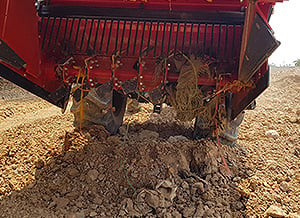 The rotor fits special shaped blades called spade blades: they present a squared profile – nor round nor smooth as on other machinery – so they can break the soil and not cutting it, avoiding the risk to compact it and crumble it too much. Behind the tilling rotor we find the selector grid, a kind of “rake” which allows to select the soil: the thinner soil in fact can pass through the rake and forms the seeding bed. On the other hand, the bigger clods, as well as stones and residues are blocked and fall down.
The combined system of tilling rotor and selector rake brings an important effect: the soil stratification. In fact, while the rotor breaks up the soil, lifts it and digs in depth, the rear rake filters the thin and the heavy soil. As the stone buriers continues its working process, the stones and residues are placed deep down the soil and the more and more refined soil is brought to the surface, forming the seeding bed.
Except some special cases, the last relevant element of the stone burier is the levelling blade, placed before the rear support roller (smooth, packer, etc).
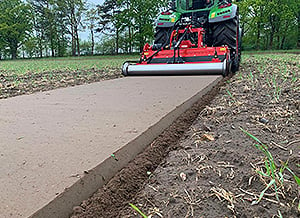 This is an additional cumulation barrier for the thin soil received by the rear selector rake. It’s important in fact to create a reserve of thin soil in order to level out the slopes caused by the absence of the stones and clods which have been removed and buried. With the levelling blade, the burying process and the soil preparation are completed: with the thin soil on surface and the stones and debris buried down, the field is ready for possible next processes (making of raised beds, flat work, etc.)
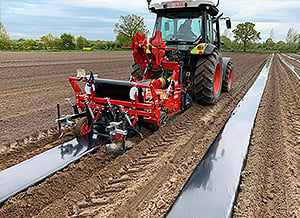 As we saw above, the stone burier can perform different jobs in just one pass: soil tillage, burying of stones and residues, reduction of clods dimensions and levelling of the field. The combination of different accessories allows to increase the simultaneous processes the machine can do (making raised beds, t-tape pipe irrigation, plastic film posing, etc.). One of the most important advantages is for sure the reduction and optimization of the time dedicated to the soil preparation. But it’s not the only advantage.
First of all, stone buriers can guarantee burying function, meaning a refinement quality which cannot be compared with other machines. In fact, the true valor of the stone burier can be seen if compared to another type of implement; the rotary tiller.
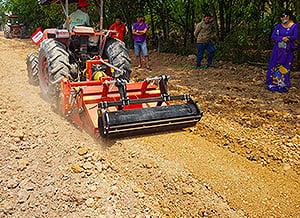 The rotary tiller, unlike the stone burier, is equipped with a tilling rotor which rotates in the same direction of the tractor, and it’s fitting standard “C” shaped blades. Since this kind of blades tend to crumble the soil and compact it to the bottom, it’s created the so-called hard pan layer. Hard pan layer means water stagnation, barrier to the growth of the roots, obstacle to the crop growth. The stone burier on the other hand, thanks to its particular working principle, avoids the formation of such hard layer, allowing the roots to growth more in depth and increase their number. Finally, we don’t have to forget the water drainage effect, highly facilitated by the soil preparation performed by the stone burier.
The stone burier represents an unreplaceable solution, especially for tillage in hard conditions, with soil full of stones and residues, thanks to its particular way of working. This type of implement is composed by four essential parts, like the frame (double or triple skin, made to resist to the shocks caused by the stones), a tilling rotor fitting special spade blades, a rear selector rake for soil filtering and a rear levelling blade for slopes adjustment.
Thanks to its peculiarity, the stone burier offers various advantages respect to other machines, among whom: time saving, avoiding of hard pan layer formation, ease-up the drainage and limiting/avoiding the water stagnation.
In this article we supplied to you all the essential information concerning the stone burier and its working principle. In case of doubts and questions about Forigo Roter Italia stone buriers, don’t hesitate to contact us: our team will be glad to help you.